Skip to content

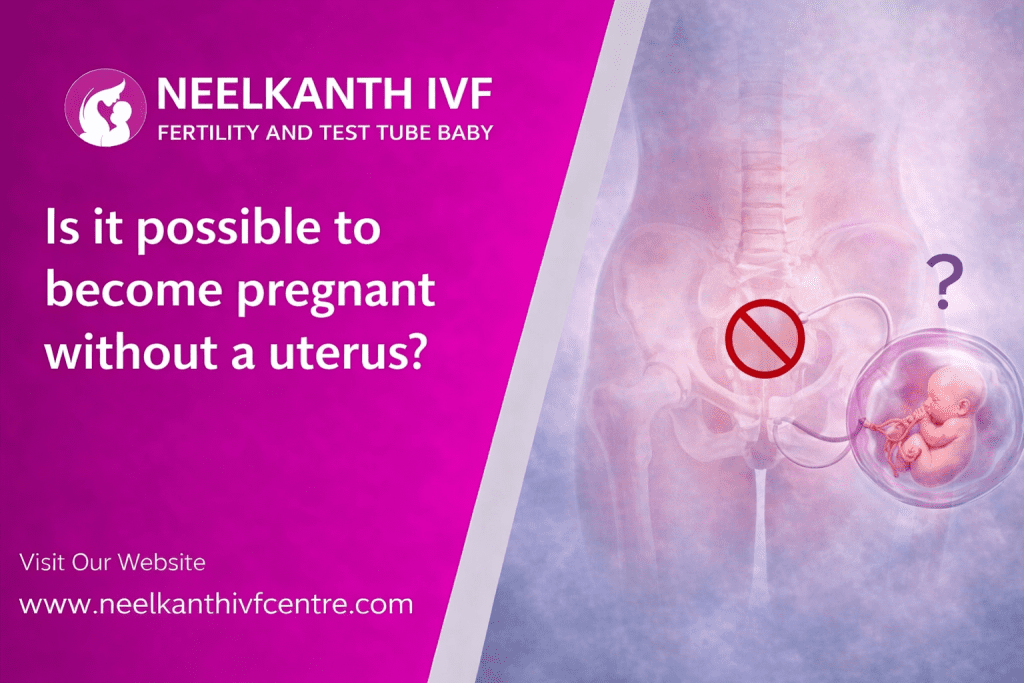
Instances of pregnancy are often considered to be natural in addition to being a miraculous part of life. For some women, particularly those who become uterus-less, the journey of conception may feel impossible. If you underwent a hysterectomy recently or were born without a uterus, then you might be asking yourself: Is it possible to become pregnant without a uterus?
In this article, we will analyze if it is possible to become pregnant without a uterus and what options do women have if they want to experience parenthood. We will go through medical facts, expert opinions, and options like surrogacy as well as uterus transplants.
Table of Contents
ToggleWhat Happens When You Don’t Have a Uterus?
The Role of the Uterus in Pregnancy
Maintaining and nurturing a pregnancy relies heavily on the uterus. It is an organ in which a fertilized egg lodges and grows into a fetus. If a woman doesn’t have such an organ, it is physically impossible for her to carry a pregnancy. Thus, when a woman loses a uterus—be it through surgical procedures, medical complications, or congenital anomalies—the ability to carry a child naturally becomes biologically impossible.
What is Hysterectomy?
Hysterectomy is the surgical removal of a woman’s uterus. It can be caused by certain types of cancers, fibroids, endometriosis, or serious infections of the pelvis. Although, after a hysterectomy a woman can no longer get pregnant, she is still able to produce eggs as the ovaries are usually removed.
Can You Get Pregnant Without a Uterus?
Scientific and Medical Perspectives
From a biological standpoint, there has to be a uterus present in order for a pregnancy to take place. A woman cannot get pregnant and carry a fetus in the conventional way without a uterus. Moreover, the eggs released from the ovaries need to be implanted in a uterine cavity for pregnancy, hence, one cannot conceive without a uterus.
What Women Face Without A Uterus.
The absence of a uterus removes the chances of a natural conception, but does not diminish the prospects of parenthood. Modern medicine provides multiple paths for women lacking a uterus to attain parenthood. However, these methods demand sophisticated techniques as well as other people’s help.
Possible Alternatives for Pregnancy Without a Uterus
Surrogate Mother as an Option
Surrogacy is perhaps one of the better options for females with no uterus. In surrogacy, a woman known as the surrogate carries and delivers the child for another woman or couple. The intended mother’s ovum could also be used and fertilized through in vitro fertilization (IVF), and the embryo is then placed in the surrogate’s womb.
Progress in IVF Technology
With technology’s progress such as IVF, it has now become possible for women who do not have a uterus to use their own eggs or donor eggs to make embryos which can then be placed in a surrogate. Although this does not allow the intended mother to physically bear the child, it still provides the opportunity to have a biological child.
Surrogacy – A Viable Option for Women Without a Uterus?
What is Surrogacy?
These days, surrogacy has become common. It is an agreement whereby a woman undertakes to carry a pregnancy for another person or couple. The process can also be divided into traditional and modern surrogacy, where the former consists of the surrogate carrying her own genetic child, and gestational where the surrogate has no genetic ties to the child. As observed, most women without a uterus prefer gestational surrogacy.
How Does Surrogacy Work?
In vitro fertilization (IVF) serves as the starting point where an ovum from the intended mother or a donor is fertilized with sperm in a lab. Following fertilization, an embryo is cultured and subsequently implanted into the surrogate’s uterus. If all goes well, the surrogate carries the child to term, after which she delivers the baby to the intended parents.
Legal and Ethical Considerations
Although surrogacy allows women suffering from uterine factor infertility to experience motherhood, it raises legal and ethical issues. Laws on surrogacy differ from one nation or state to another, which means that all concerned parties must be guided by the legal landscape surrounding surrogacy contracts.
What Are the Challenges of Pregnancy Without a Uterus?
Emotional and Psychological Aspects
The wish not to carry a pregnancy to term is often emotionally difficult. Many experience feelings of insufficiency. And to help improve one’s mental wellbeing – counseling can be vital, which underscores the need for emotional aid.
Medical Risks and Health Problems
Aside from the emotional difficulties, there are some specific medical risks that are related to assisted reproductive technologies like IVF and Surrogacy. These encompass the risks of multiple pregnancies, ovarian hyperstimulation syndrome (OHSS), as well as other risks that may occur during the IVF procedure.
Can A Woman Become Pregnant With A Uterus Transplant?
Uterus Transplant – A Revolutionary Concept
A uterus transplant is classified as an experimental surgical procedure that consists of performing a surgical operation to transfer a healthy uterus to the woman who does not have it or who has undergone a hysterectomy.
Barring some successful cases, women have been delivered after undergoing successful transplanted uterus surgeries, which makes this experimental surgery promising.
Final Thoughts
To summarise, it is biologically impossible for a woman without a uterus to conceive and carry in any case, but there are several different forms of options available. For instance, women who want to experience motherhood can do so through surrogacy, which is one of the most common options available. In addition, there are other forms of hope such as arising medical advancements in the form of surgery to transplant a uterus, but those come with their fair share of risks and complications. Ultimately, there are indeed achievable ways to help women without a uterus fulfil their dream of motherhood; however, they need to be properly guided and supported in terms of options that exist and require serious consideration.